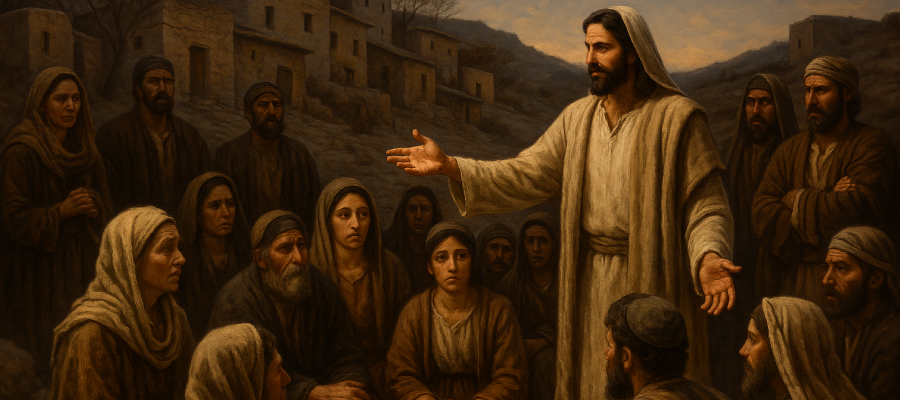
Honor–Shame Culture in the Sermon on the Mount
When most Western readers approach the Sermon on the Mount, it feels like a set of moral rules: be kind, love enemies, do good. But for Jesus’ first-century disciples, His words cut into the very fabric of their world—an honor–shame culture where family reputation, social standing, and public recognition defined survival. Honor was currency that determined access to community, marriage, and livelihood. Shame meant exclusion, mockery, or even expulsion. Into this fragile world, Jesus’ words landed like fire. He declared that God’s honor does not flow through human systems of status but through His kingdom. In doing so, He turned the entire honor economy upside down, lifting the shamed and humbling the powerful.
Western Misunderstanding vs Eastern Reality
- Western frame: Morality is private. Religion is about me and God.
- Eastern Jewish frame: Morality was public. Worth was measured in honor and shame, tied to how one’s family, village, and community judged a person. Every action either added to or subtracted from collective reputation.
Jesus’ words, then, were not private advice for individual spirituality. They struck at the heart of society’s operating system. His Sermon redefined what counted as true honor, taking it out of the hands of public opinion and placing it firmly in God’s hands. What sounded like simple virtues to Western ears were revolutionary statements to Eastern ones: the poor, the meek, and the persecuted were no longer disgraced but held in highest esteem by the Father.
Beatitudes – Shame Reversed into Honor
Western readers treat the Beatitudes as gentle comfort: the poor and meek will be rewarded later. But in first-century culture, poverty and meekness were marks of shame because they signaled failure in the honor economy. A poor man could not provide for his family, the meek lacked visible power or status, and both were easily dismissed as dishonorable. To be in these categories was to live on the margins, carrying the stigma of disgrace. A persecuted person was disgraced. Jesus declared them “blessed”—publicly honored by God.
Matthew 5:3–10 “Blessed are the poor in spirit… Blessed are the meek… Blessed are those who are persecuted because of righteousness.”
In a world where honor was scarce and controlled by elites, Jesus announced that honor flowed freely from the Father. The shamed stood at the center of His kingdom.
Turn the Other Cheek – Refusing Humiliation
Western readers see “turn the other cheek” as weakness. But a slap on the right cheek was not violence—it was a public insult with the back of the hand. To turn the other cheek forced the aggressor to strike as an equal, this time with the open palm of the hand rather than a degrading backhand, exposing injustice without retaliation. In an honor–shame culture, refusing to accept the insult preserved dignity. It denied the aggressor the power to define your status, and at the same time, it avoided escalating the cycle of retaliation.
Matthew 5:39 “If anyone slaps you on the right cheek, turn to them the other also.”
Jesus gave His disciples a way to resist shame while rejecting cycles of violence, modeling a third way between passive submission and violent revenge.
Secret Generosity – Redirecting Honor
Charity in Jewish life often came with recognition. Wealthy donors gained status by giving in public. But Jesus redirected honor away from humans.
Matthew 6:1–4 “Be careful not to practice your righteousness in front of others to be seen by them… your Father, who sees what is done in secret, will reward you.”
Acts of generosity became worship, not self-promotion. Dignity was preserved for the poor, and glory went to the Father.
Love Your Enemies – Breaking the Honor Code
In an honor–shame world, loyalty was owed to friends and retaliation to enemies. Showing kindness to an enemy would have been seen as weakness or even betrayal of your group. Jesus dismantled that boundary and reframed honor itself.
Matthew 5:44 “Love your enemies and pray for those who persecute you.”
God sends sun and rain to all. His disciples must reflect His indiscriminate generosity. Loving enemies was not about feelings but about actively breaking cycles of vengeance and extending dignity across hostile boundaries. This was not sentiment but a radical break with the honor code that ruled society.
Salt and Light – Whose Reputation?
In Jewish thought, a person’s “name” (shem) was tied to family honor. To shine in public meant elevating your family’s standing. Geography reinforced this imagery as well: villages on hillsides were visible for miles, and even a single lamp in a clustered home could cast light into surrounding spaces. Reputation and honor could not be hidden. Jesus reframed this:
Matthew 5:13–16 “You are the salt of the earth… You are the light of the world… let your light shine… that they may glorify your Father in heaven.”
The point was not self-branding but redirecting reputation to God. His listeners would have pictured their own hilltop towns and household lamps, realizing that their lives were meant to illuminate God’s name across the community and beyond.
Anxiety and the Myth of Scarcity
First-century people believed resources—including honor—were scarce. If one gained, another lost. This assumption shaped daily competition over land, food, and recognition. Families guarded what little they had, fearing that generosity or failure could lower their standing and diminish their reputation. Anxiety was woven into the system because survival felt like a zero-sum game. Jesus shattered this “limited good” worldview by pointing to God as the true source of provision.
Matthew 6:25–26 “Do not worry about your life, what you will eat or drink… Look at the birds of the air.”
If God feeds sparrows and clothes lilies, then provision and honor in His kingdom are not scarce but overflowing. The message is clear: life in God’s economy is not about hoarding or competing but about trusting His abundant care. Anxiety collapses when we rely on His generosity instead of fearing loss.
Big Idea
Reflection
- Where have you confused honor with human approval?
- How can you protect someone’s dignity this week?
- What would it look like to live free from the honor game?
✨ SHEMA Lesson: Hear • Believe • Obey
- Hear: Jesus redefines honor. The dishonored are blessed, and cycles of shame are broken.
- Believe: Your value is not measured by status but by the Father’s blessing.
- Obey: Live the kingdom honor code—refuse insult, give in secret, and redirect praise to God.
Keep Walking
- Want to learn more? Explore our blog page to deepen your understanding of the Bible in its original context.
- Discover how the SHEMA Bible App helps you trace word pictures, remez, and hidden threads across Scripture. Join the waitlist